Picture week two. Your fingertips sting, the chord changes still drag, and nobody has told you what to practice next. That is the week a good course earns its keep.
For that week, the answer is Guitar Tricks, the best online guitar lesson site for most beginners in 2026, with a structured path and a free Basic account. Its Core Learning System sets the next lesson for you, which removes the easiest excuse to stop.
Past the basics, TrueFire is the depth pick, with All Access at $29.99 a month or $20.83 a month billed annually. If you want a named master teacher to watch your playing and reply on video, ArtistWorks is the one. All 9 courses and apps below list their price, trial and refund terms, and every one has a free tier, a free trial or a money-back guarantee.
No plan on this page includes tougher fingertips. Those you earn the old way.
MIDDERMUSIC may earn a commission if you buy through some links on this page, at no extra cost to you. Commissions do not influence which products appear here or how they rank.
| Product | Best for | Score | Key points | Link |
|---|---|---|---|---|
| Our Top PickGuitar Tricks | Best overall for beginners | 4.5/5 |
| Visit Guitar Tricks |
| Best for DepthTrueFire (with JamPlay) | Biggest library | 4.0/5 |
| Visit TrueFire |
| Best for FeedbackArtistWorks | Video feedback from a master | 4.5/5 |
| Visit ArtistWorks |



Which online guitar lessons are best for you?
Guitar Tricks is the best all-round choice, but how you like to learn decides the rest. Use this table to jump to the review that fits.
| Best for | Pick | Why | Starts at |
|---|---|---|---|
| Best overall for beginners | Guitar Tricks | Step-by-step core path plus a large song library | Free Basic account; $29.95/mo |
| App-style lessons with feedback | Fender Play | Seven levels built around songs; guitar, bass and ukulele | $19.99/mo or $149.99/yr |
| Free structured course | JustinGuitar | Long-running free beginner course on the web | Free website course; app $64.99/yr |
| Biggest library | TrueFire (with JamPlay) | 1,900+ courses and 30,000+ jam tracks | $20.83/mo billed annually |
| Video feedback from a master | ArtistWorks | 19 guitar schools; Premium adds Video Exchange | $19.99/mo or $191.88/yr |
| Live streams with the teacher | Andy Guitar | Weekly live streams for members; 60-day guarantee | Free account; £10.99/mo |
| Weekly live group lessons | Rock Like The Pros | Live sessions plus 10 courses | $19.95/mo |
| Buying single courses outright | Marty Music | Free lessons and courses you keep | Free lessons; courses from $68 |
| Follow-along practice sessions | Guitareo | 12-step Method; drum, piano, singing and bass lessons included | $30/mo or $279/yr |
How do you choose online guitar lessons?
Start with the kind of feedback you want, then look at the price model. Those two points narrow the list faster than the size of any lesson library.
- Feedback: most sites here give you video lessons and leave the checking to you. ArtistWorks Premium and the Guitar Tricks feedback option let you send a video and get a reply. Fender Play listens to your playing for in-app feedback. Andy Guitar, Rock Like The Pros and Guitareo add live sessions.
- Price model: Guitar Tricks, TrueFire, ArtistWorks, Rock Like The Pros and Guitareo are subscriptions. Marty Music and Rock Like The Pros also sell single courses you pay for once. JustinGuitar and Marty Music both have large free catalogs.
- Level: Guitar Tricks, Fender Play and JustinGuitar suit day-one beginners best. TrueFire and ArtistWorks reward players who already know their open chords, and the picks by playing level after the reviews go further.
- Songs or technique: Fender Play and Andy Guitar build lessons around songs you already know. TrueFire and ArtistWorks lean toward technique and style study, and Guitar Tricks pairs a core skills path with 1,000+ song lessons.
- Practice tools: slowing a hard passage down and looping it fixes a riff faster than replaying the whole lesson. TrueFire has slow motion and looping on every course, Fender Play has looping and a metronome, and Guitar Tricks, Fender Play and TrueFire all show tab beside the video.
- Style: ArtistWorks is strong for bluegrass, blues, jazz and classical. If classical is your main goal, there is a separate shortlist of classical guitar lessons online.
- Live teacher: if you want a person watching your hands, see how live, recorded and in-room lessons compare further down.
- Instrument: any working acoustic or electric guitar will do. Buying your first one? Start with an acoustic guitar suited to beginners.
- Trial and refund terms: trial lengths run from 7 to 14 days, and guarantees run from one week to 90 days. Read them before you enter card details.
1. Guitar Tricks: best overall for beginners
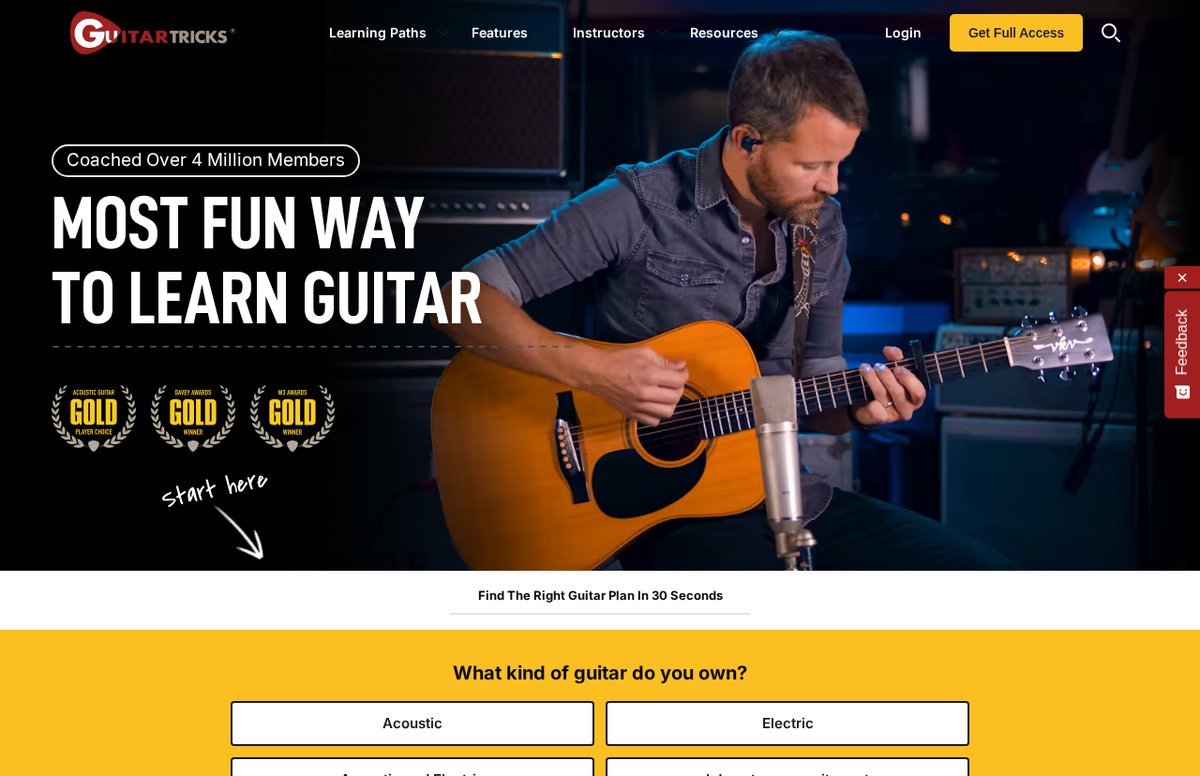
Jon Broderick launched Guitar Tricks from San Francisco in 1998 as a subscription guitar school, and Full Access costs $29.95 a month or $179 a year. The site holds more than 11,000 video lessons from over 40 instructors, and the company says it has taught more than 4 million players.
Guitar Tricks takes the top spot because its Core Learning System gives a beginner a clear order to follow, from two Fundamentals courses into four style courses.
Verdict: One clear road from your first chord to full songs, and a song library deep enough to keep you on it.
Who is Guitar Tricks best for?
Guitar Tricks is best for beginners and returning players who want someone else to set the order of lessons. It also suits players who know their style, since every style course builds on the same foundation.
What does a first week on Guitar Tricks look like?
Fundamentals 1 is taught by Anders Mouridsen, a touring guitarist who has played with Taylor Swift, P!nk and John Fogerty. The first chapter covers tuning and finding notes, then a Simple Chords tutorial. That tutorial starts with a no-finger E minor and a one-finger G major, and it ends with your first song, “Three High”. Chapter one then adds picking, six-string chords and chord switching.
How deep does the Guitar Tricks curriculum go?
Fundamentals 1 runs through rhythm and strumming, the major and minor pentatonic scales, power chords, rock and blues riffs, and chord families in G, A, C and A minor. Fundamentals 2 adds more chords, fingerpicking and harder strumming. The four style courses then teach the tones, rhythms and phrasing of each genre. The skills and song libraries then carry you into intermediate playing.
Does Guitar Tricks give feedback on your playing?
Yes, as an add-on. The coaching menu lets you send a video and get direct feedback, book a live lesson with an instructor or ask for a personal practice guide. These sit outside the Full Access price.
How does Guitar Tricks compare with other beginner courses?
Next to Fender Play, Guitar Tricks has a far bigger library and an optional human coach, while Fender Play feels more like an app and costs less per year. JustinGuitar teaches a similar foundation for free on the web, but it has no paid coaching and a smaller song library on the site.
- Choose Guitar Tricks if you want one guided path plus a huge song library.
- Choose Fender Play if short, song-led lessons on a phone keep you practicing.
- Choose JustinGuitar if you want a structured course and don’t want to pay.
Where it’s strong
- Clear beginner path through four styles
- Over 11,000 lessons and 1,000+ songs
- 60-day money-back guarantee
Where it falls short
- Monthly price is higher than Fender Play’s
- Video feedback and private lessons cost extra
Pick it if you want a guided course and a big song library in one place. Skip it if you already play and mainly want advanced jazz or bluegrass.
For most beginners, this is the one to beat.
Full review: Guitar Tricks review · Compare: Guitar Tricks vs Fender Play · Guitar Tricks vs JustinGuitar
2. Fender Play: best app-style lessons for beginners
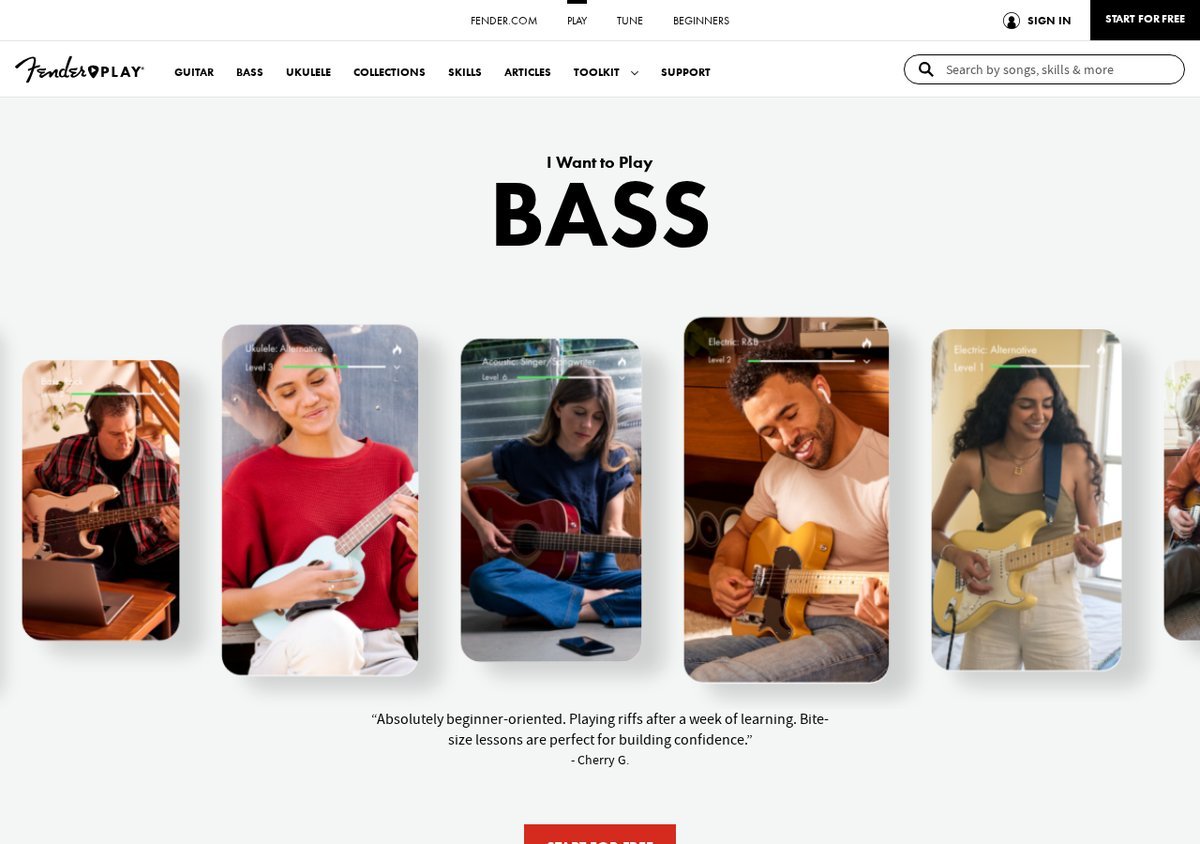
For $19.99 a month or $149.99 a year, which works out to $12.50 a month, Fender Play gives you Fender’s own lessons for electric and acoustic guitar, bass and ukulele. Annual members also get 10% off Fender gear. The app comes from the company Leo Fender started in 1946, and songs drive every level.
Fender Play asks you to choose an instrument and a genre when you sign up. Guitar players pick from rock, pop, blues, country, folk and R&B/soul. That choice sets a learning path of five to seven levels, each made of short courses and activities. Fender’s page says the app gives instant feedback when you play a song or riff.
Verdict: Song-first lessons in bite-size pieces, straight from Fender. Pick it if short sessions on your phone keep you practicing.
Who is Fender Play best for?
Beginners who quit when lessons feel like homework get the most out of Fender Play. Each skill arrives inside a song, so you play something recognizable within days. It also suits a household that wants guitar, bass and ukulele under one subscription.
What does a first week on Fender Play look like?
Level 1 starts with the parts of the guitar, holding it and the pick, and tuning. You then play single notes and a simple riff before moving to strumming and your first chords, such as E minor. Fender lists “Baba O’Riley”, “Good Riddance (Time of Your Life)” and “Satisfaction” among the Level 1 rock songs, so your first week ends with a real tune.
How deep does the Fender Play curriculum go?
Level 2 adds power chords, reading tab and the musical alphabet, with songs such as “Come As You Are” and “Black”. Level 3 brings in the E minor pentatonic scale and moveable power chords. By Level 7 the path reaches double stops, bends and arpeggio picking.
How does Fender Play’s feedback work?
The app listens as you play selected songs and riffs and shows how closely you matched them, with a score to chase. No instructor sees your playing, so human correction means a teacher or a video review service.
Which beginners should choose Fender Play over a full lesson site?
Fender Play is cheaper per year than Guitar Tricks and more app-like, but it has fewer advanced courses and no paid coaching. JustinGuitar gives you a deeper free course on the web, with its own paid app for play-along songs. Andy Guitar adds weekly live streams with the teacher.
- Choose Fender Play if you want short song-based sessions on any device.
- Choose Guitar Tricks if you want a bigger library that lasts into intermediate playing.
- Choose Andy Guitar if live contact with a teacher keeps you going.
Where it’s strong
- Clear genre paths with songs at every level
- Covers bass and ukulele too
- Works on web, iOS and Android with synced progress
- 14-day trial on the annual plan
Where it falls short
- Less depth for intermediate players than TrueFire or ArtistWorks
- No refunds once a billing period starts
Pick it if you want bite-sized lessons and quick songs on a phone. Skip it if you want long-form courses in jazz, bluegrass or classical.
Riffs first, homework never.
Full review: Fender Play review · Compare: Fender Play vs JustinGuitar
3. JustinGuitar: best free structured course
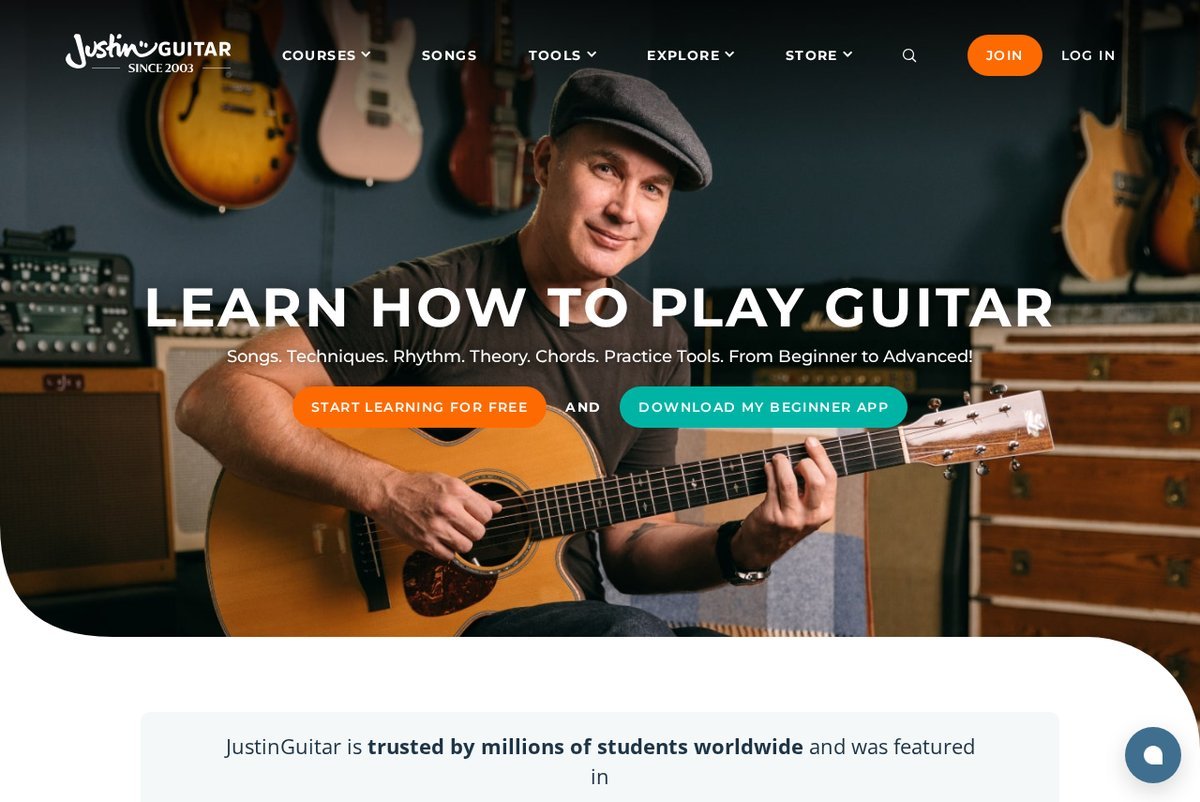
The whole JustinGuitar course sits free on the website, and only the Lessons & Songs app costs money: $64.99 a year for play-along songs and practice tools. The school belongs to Justin Sandercoe, an Australian guitarist based in London who played in Katie Melua’s live band and taught her guitar. He launched the site in 2003 and has posted lessons on YouTube since 2006.
JustinGuitar is the pick for learners who want structure without a subscription. The website course runs through nine grades in three stages: beginner, intermediate and advanced. Each grade holds about six modules, and most lessons run 8 to 20 minutes with written notes and chord diagrams.
Verdict: A full graded course for the price of a browser tab. Pay only if you want the play-along app.
Who is JustinGuitar best for?
Self-motivated beginners on a tight budget come first here, along with players who like a teacher who explains why, not only what. It also suits returning players who want to rebuild their basics in order.
What does a first week on JustinGuitar look like?
Grade 1 Module 1 teaches the A and D chords and has you play your first song with them. You then practice “One Minute Changes”, where you count how many clean switches you make in a minute. Justin’s target is 30 full changes. Module 2 adds the E chord, basic rhythm and your first riff.
How deep does the JustinGuitar curriculum go?
Grade 1 has 75 lessons and closes with a consolidation module before you move on. Grade 2 has 68 lessons and adds new chords and strumming patterns. Grade 3 completes the beginner stage. The intermediate and advanced grades then move into blues, scales and theory.
What does the JustinGuitar app add?
The app gives you Justin’s hand-picked songs for each module, with adjustable backing tracks, lyrics and chord charts. It covers Grades 1 to 3 with 210 video lessons. After the 7-day trial, free users keep some early content and 30-second song previews.
Which free or low-cost route fits you best?
On the web, JustinGuitar costs nothing, while Guitar Tricks adds a much larger song library and optional paid feedback. Marty Music also has a big free catalog, though its free lessons are song tutorials rather than a graded course. Fender Play packages a shorter path in a polished app.
- Choose JustinGuitar if you want a graded course and are happy to pace yourself.
- Choose Guitar Tricks if you want songs and coaching in one place.
- Choose Marty Music if you mainly want to learn specific songs for free.
Where it’s strong
- Full beginner to advanced course on the web at no cost
- Clear grades with consolidation steps
- Teacher with a long performing career
- Large community forum
Where it falls short
- Song play-along needs the paid app
- No personal video feedback
Pick it if you want a graded course and clear explanations for free. Skip it if you need someone to review your playing.
Free, graded and patient: the excuses run out fast.
Compare: Fender Play vs JustinGuitar · More free options: best YouTube guitar lessons
4. TrueFire (with JamPlay): best library for players past the basics
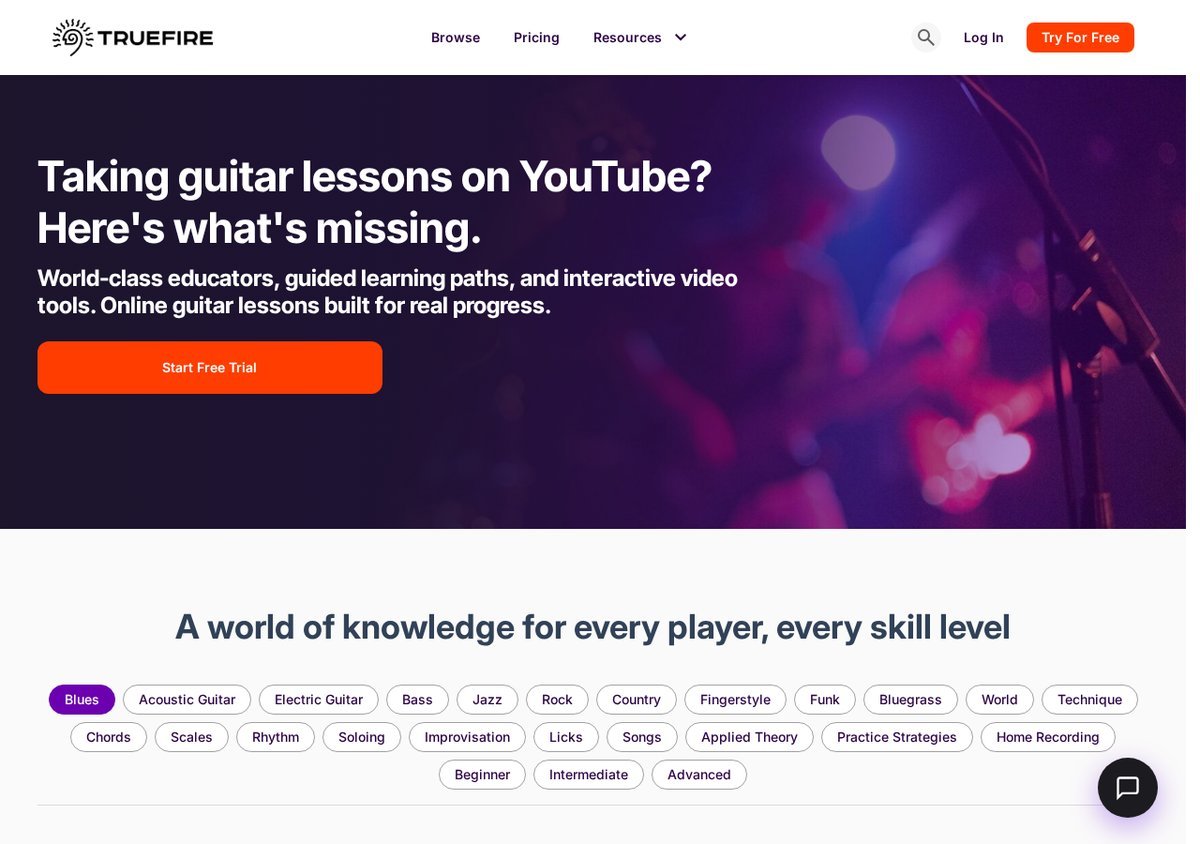
Two catalogs now sit under one membership: sister site JamPlay has merged its lessons into TrueFire, a guitar lesson library with All Access at $29.99 a month or $20.83 a month billed annually. Brad Wendkos founded the company in 1991 and moved it online in 1999.
TrueFire is the depth pick for players past the basics. The library lists more than 85,000 video lessons, 1,900+ courses and 30,000+ jam tracks. Its faculty includes Grammy winners and session players such as Tommy Emmanuel, Larry Carlton, Robben Ford and Brent Mason.
Verdict: A bottomless library for players who know their open chords. Bring a goal, and a Learning Path will set the order.
Who is TrueFire best for?
TrueFire rewards intermediate and advanced players who already know what they want to study. Blues, jazz, fingerstyle and country players get the most from it, because those styles have the deepest course lists.
What does a first week on TrueFire look like?
A Learning Path starts by placing you at a level, then sets out a list of core courses in order. A typical first week means working through the opening lessons of one core course with its synced tab, slowing hard passages down and looping them. Many members also jam over an In The Jam session, which lets you mute the guitar part and play along with the band.
How deep do TrueFire’s Learning Paths go?
Each guitar Learning Path has 13 to 18 core courses, and each core course recommends extra courses on the same topic, so the reading list grows as fast as you do. A single path can keep you busy for years.
Is TrueFire good for complete beginners?
It can be, but it is not the easiest start. The library is huge, and a Learning Path is a long road for someone on day one. If you are starting from zero, a guided course such as Guitar Tricks or JustinGuitar is easier, and TrueFire is a strong second step.
TrueFire or a one-teacher school?
TrueFire puts hundreds of teachers in one subscription, while ArtistWorks gives you one master and personal video feedback. Guitar Tricks has the clearer beginner path but a smaller advanced catalog.
- Choose TrueFire if you want variety and depth.
- Choose ArtistWorks if you want one teacher’s method and replies to your videos.
- Choose Guitar Tricks if you are still working on your first chords.
Where it’s strong
- Largest course library on this list
- Video-synced tab, slow motion and looping on every course
- Named Grammy-winning and session faculty
- One plan covers both TrueFire and JamPlay
Where it falls short
- Harder for day-one beginners to find a route
- Downloads cost extra
Pick it if you want deep, varied courses at a low yearly price. Skip it if you want one simple path from your first lesson.
Past the open chords, no library here goes deeper.
Full reviews: TrueFire review · JamPlay review · Compare: TrueFire vs Guitar Tricks · JamPlay vs TrueFire
5. ArtistWorks: best for video feedback from a master teacher

Each of the 19 online guitar schools at ArtistWorks is built around one teacher, with Standard at $19.99 a month and Premium at $29.99 a month. David and Patricia Butler founded the company in 2008. David was a technology executive at AOL. Its Video Exchange system now holds more than 160,000 exchanges across all instruments.
ArtistWorks stands out because the teachers are master players. The guitar faculty includes Bryan Sutton for bluegrass, Paul Gilbert for rock, Jason Vieaux for classical, Keith Wyatt for blues and Martin Taylor for fingerstyle. On Premium, at schools that offer it, you send a video of your playing and the teacher replies with a personal video lesson.
Verdict: One master, one method and, on Premium, a video reply aimed at your own playing.
Who is ArtistWorks best for?
ArtistWorks makes the most sense for players committed to one style who want a master’s method. It also suits adult beginners, through two dedicated schools: David Butler’s Beginner’s Guide to Acoustic Guitar and Kevin Barry’s adult beginner rock school.
What does a first week on ArtistWorks look like?
You choose one school and start at the first level of that teacher’s curriculum. In a beginner school that means holding the guitar, first chords and simple strumming. In a style school, the first level sets up that genre’s core technique and a first tune. You can also browse the Video Exchange library to watch the teacher correct other students on the same lesson.
How deep do ArtistWorks schools go?
Most schools run in levels from beginner to advanced, with sheet music, tab and backing tracks. Paul Gilbert’s rock school spans that whole range. Gilbert alone has recorded more than 12,000 Video Exchanges. That archive is often as useful as the lessons themselves.
How does ArtistWorks Video Exchange work?
You watch a lesson, record yourself playing it and upload the video. The teacher records a reply with tips and a practice plan. The exchange then joins the school’s shared library for every student.
Where does ArtistWorks beat the big libraries?
Against TrueFire, ArtistWorks has far fewer lessons, but each school follows one master from start to finish and adds personal replies. Guitar Tricks offers paid video feedback too, but from staff instructors across a broad library. Rock Like The Pros gives you live group contact instead of recorded replies.
- Choose ArtistWorks if one style and one master matter most.
- Choose TrueFire if you want many teachers and styles in one subscription.
- Choose Rock Like The Pros if you prefer asking questions live.
Where it’s strong
- Named masters with deep style knowledge
- Personal video replies on Premium
- Shared library of past exchanges
- 7-day trial at every school
Where it falls short
- One school per subscription
- Premium is not available at every school
Pick it if you love one style and want a master’s method. Skip it if you want many styles under one subscription.
Pick your style first, then pick your master.
Full review: ArtistWorks review · Compare: TrueFire vs ArtistWorks
6. Andy Guitar: best for live streams with the teacher
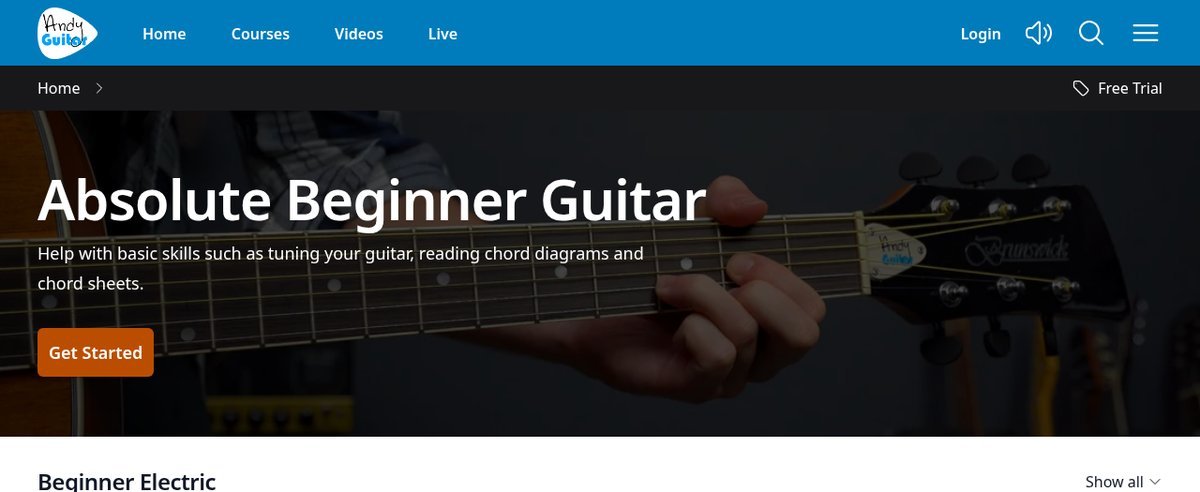
Andy Crowley’s YouTube channel has more than 2.7 million subscribers and over 310 million views, which makes him one of the most watched guitar teachers online. His UK school, Andy Guitar, pairs a free account with an Access All Areas membership at £10.99 a month or £99.99 a year. Membership comes with a 10-day free trial and a 60-day money-back guarantee.
Beginners who want contact with the teacher should look here first. Members join weekly live streams where Andy takes requests, answers questions and jams through songs. A Discord community, where Andy is active, fills the gaps between streams.
Verdict: A friendly beginner course with a live line to the teacher, and a song list steeped in British rock and Britpop.
Who is Andy Guitar best for?
If you are an adult beginner who wants a calm teacher and songs you already know, Andy Guitar fits. The catalog leans toward Oasis, Nirvana, Coldplay, Kings of Leon and other British and alternative rock.
What does a first week on Andy Guitar look like?
The natural way in is the free 10-day starter course, which opens with the “Absolute Beginner? Start Here!” lesson. Over the ten days you learn first chords, strumming patterns, a little fingerstyle and a simple scale. Each day builds toward songs you can play, and the lessons run in any web browser or the Andy Guitar app.
How deep does the Andy Guitar curriculum go?
The Beginner Acoustic and Beginner Electric paths cover three-chord songs, strumming patterns and a consolidation course. The Intermediate Acoustic pathway runs in five or more parts and includes fingerstyle and singer-songwriter techniques. Other courses add the major pentatonic scale and rhythm embellishments.
What happens in the live streams?
Weekly streams work through themes and song requests collected in the Discord. Members ask questions in real time, and replays sit in the library. It is group contact, not one-to-one correction.
Is Andy Guitar the right live option for you?
Andy Guitar and Rock Like The Pros both offer live contact. Andy has the bigger song catalog and the longer guarantee, while Rock Like The Pros has a US teacher and single courses you can buy alone. Marty Music also runs member livestreams, with more focus on courses you keep. Fender Play costs a little more but adds bass and ukulele.
- Choose Andy Guitar if you want a gentle beginner path and live sessions.
- Choose Rock Like The Pros if you prefer US pricing and weekly group lessons.
- Choose Marty Music if you would rather own single courses.
Where it’s strong
- Weekly live streams with the teacher
- 60-day money-back guarantee
- Large free starting point, including a 10-day course
- Big library of rock and indie song lessons
Where it falls short
- Priced in pounds only
- Focus is beginner and early intermediate
Pick it if you want low-pressure beginner lessons with live contact. Skip it if you want advanced jazz or classical study.
Come for the beginner path; stay for the live streams.
7. Rock Like The Pros: best for weekly live group lessons
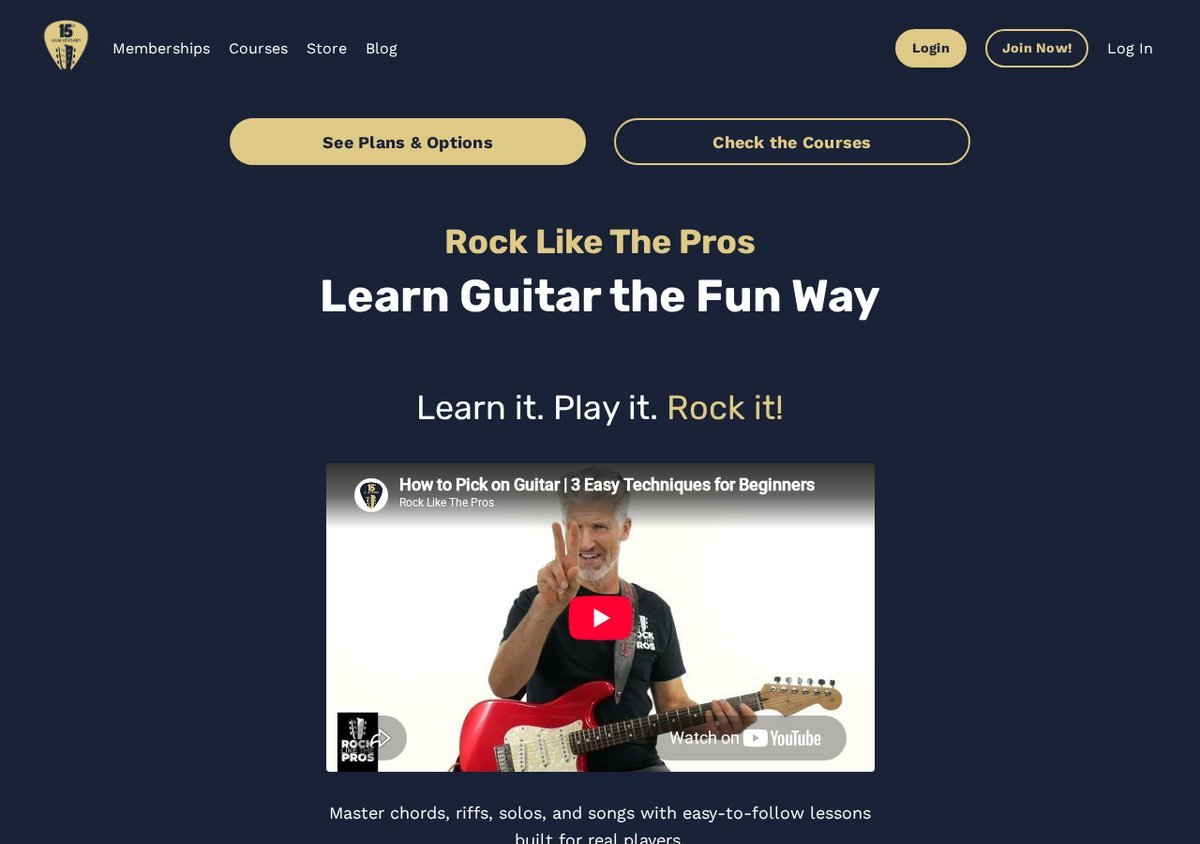
Terry Carter, the San Diego guitarist and Los Angeles studio player behind Rock Like The Pros, has worked with Weezer, Josh Groban, Robby Krieger and Duff McKagan. His site sells a Monthly Premium membership at $19.95 and single courses at $37. A yearly plan costs 25% less than paying monthly, and both membership options carry a 30-day money-back guarantee.
The site is built around weekly live guitar sessions where members ask questions in real time. Carter also runs the sister site Uke Like The Pros, so the teaching style draws on years of beginner-friendly video courses. Members also get a members’ guide and a gift card for the Terry Carter Music Store.
Verdict: A standing weekly date with a working studio player. Show up with the question that has been bugging you all week.
Who is Rock Like The Pros best for?
The fixed weekly session is the hook here, which makes it a fit for beginners and early intermediate players who practice better with one on the calendar. It suits adults who want a working musician to explain rhythm, timing and chord charts.
What does a first week on Rock Like The Pros look like?
New members can start with the free Strumming Mastery course, the free chord chart and the beginner course. Early lessons cover open chords, steady strumming patterns and basic rhythm with a backing track. You then join your first live session to ask about anything that isn’t clicking.
How deep does the Rock Like The Pros curriculum go?
The 10 courses run from beginner through intermediate to advanced. Later courses cover lead guitar, soloing, rhythm mastery, advanced strumming and blues. The library is smaller than a full school, but each course has tab, sheet music and backing tracks to download, and the topics stretch from fingerstyle to rock.
Can you buy one course without a subscription?
Yes. Each course sells alone for $37, and you keep it. That makes it easy to try Terry’s teaching before you join.
Live group lessons or recorded feedback?
Rock Like The Pros has fewer song lessons than Andy Guitar, but it bills in dollars and sells single courses. ArtistWorks gives you a recorded personal reply from a master, which is slower but more detailed. Guitar Tricks offers a much larger library with paid one-to-one lessons.
- Choose Rock Like The Pros if you want weekly live contact at a modest price.
- Choose ArtistWorks if you want a teacher who watches your own playing.
- Choose Guitar Tricks if library size matters most.
Where it’s strong
- Weekly live sessions with instructors
- Downloadable tab, sheet music and backing tracks
- Single courses at $37
- Teacher with studio and touring credits
Where it falls short
- Smaller library than Guitar Tricks or TrueFire
- No personal video review
Pick it if you want live contact at a modest monthly price. Skip it if you want the largest possible lesson library.
Accountability, delivered every week.
8. Marty Music: best for buying single courses outright
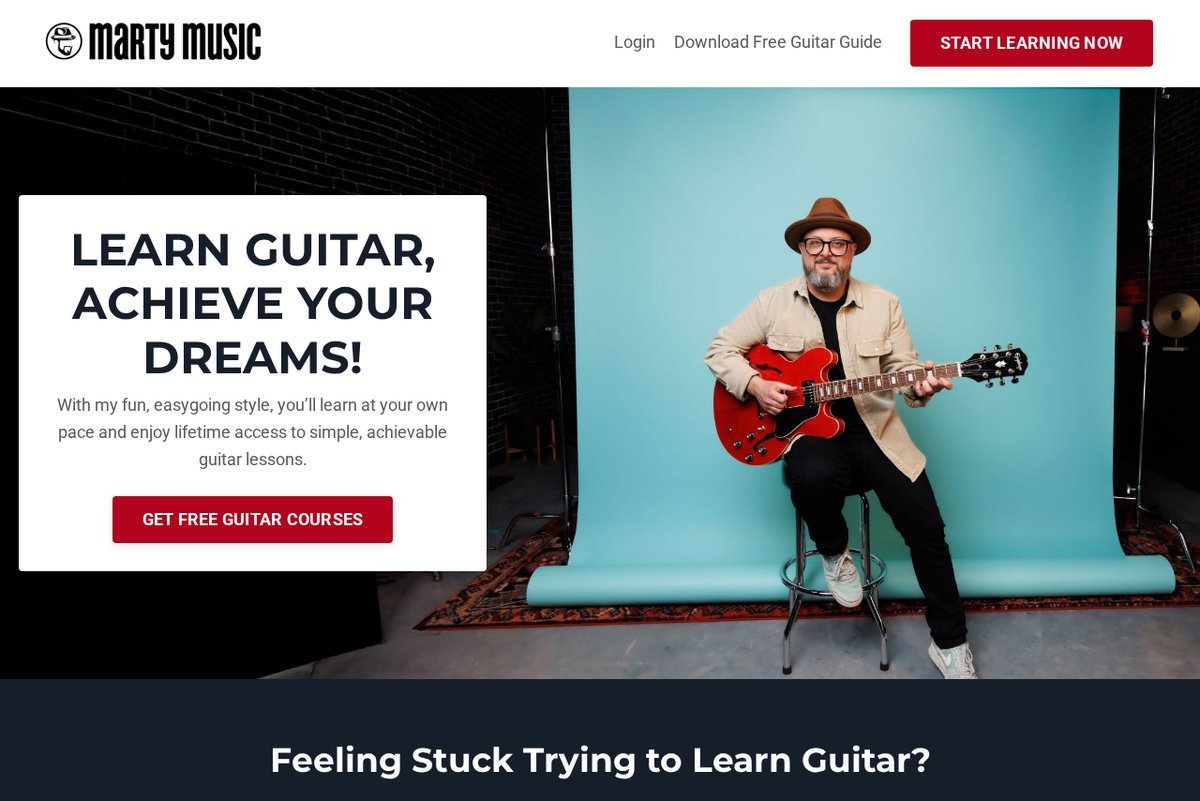
Marty Music is Marty Schwartz’s guitar site, with free lessons and paid courses you keep, such as a $68 course and a $92 intermediate course. Schwartz has taught guitar since the 1990s and built one of the biggest guitar channels on YouTube. His site says he has helped millions of people learn over the last 20 years.
Learners who dislike subscriptions are the people this site is built for. Each course is a one-time purchase that you can stream and download forever. Memberships exist too: VIP at $10 a month and All Access at $24.99 a month, which adds every course Marty teaches.
Verdict: Pay once and keep the course for good, taught by the man behind one of YouTube’s biggest guitar channels.
Who is Marty Music best for?
Marty Music works for beginners and early intermediate players who like a relaxed teacher and want to own what they buy. It suits rock and acoustic players who already watch Marty’s song tutorials. The free Fan tier, with free courses, the community and a free guitar guide, lets you try the teaching before you spend anything.
What does a first week on Marty Music look like?
The easy way in is the free courses and YouTube song lessons. If you buy a beginner course, the first lessons cover simple chords, strumming and an easy song, each with PDF tab. Marty’s method skips heavy theory early on and gets you playing quickly, and downloads let you practice offline.
How deep do Marty Music courses go?
Each course aims at one goal, from first chords to first solos. The Intermediate Foundation for Electric Guitar course builds technique for players past the basics. New courses join All Access 60 days after launch, and artist master courses sit outside it. VIP adds private livestreams and song polls.
Are Marty Music courses a one-time payment?
Yes. The course pages say you can stream and download them forever, with no membership or recurring charge. Courses bought earlier stay yours whatever tier you choose.
Should you buy courses or subscribe?
Where Rock Like The Pros sells $37 single courses next to a live membership, Marty Music sells single goal-based courses you can download. JustinGuitar gives you a free graded course but no course downloads. Andy Guitar bundles everything in a monthly membership with live streams.
- Choose Marty Music if you want to own one focused course.
- Choose Rock Like The Pros if you want a course you keep plus a live session each week.
- Choose JustinGuitar if you want a full free path.
Where it’s strong
- Courses you own and can download
- Large free lesson catalog
- Membership tiers from free to private lessons
Where it falls short
- Less structure than a full school
- Artist master courses sit outside All Access
Pick it if you want a single focused course with no subscription. Skip it if you want one guided curriculum from start to finish.
Your course, your hard drive, no renewal date.
9. Guitareo: best for follow-along practice sessions
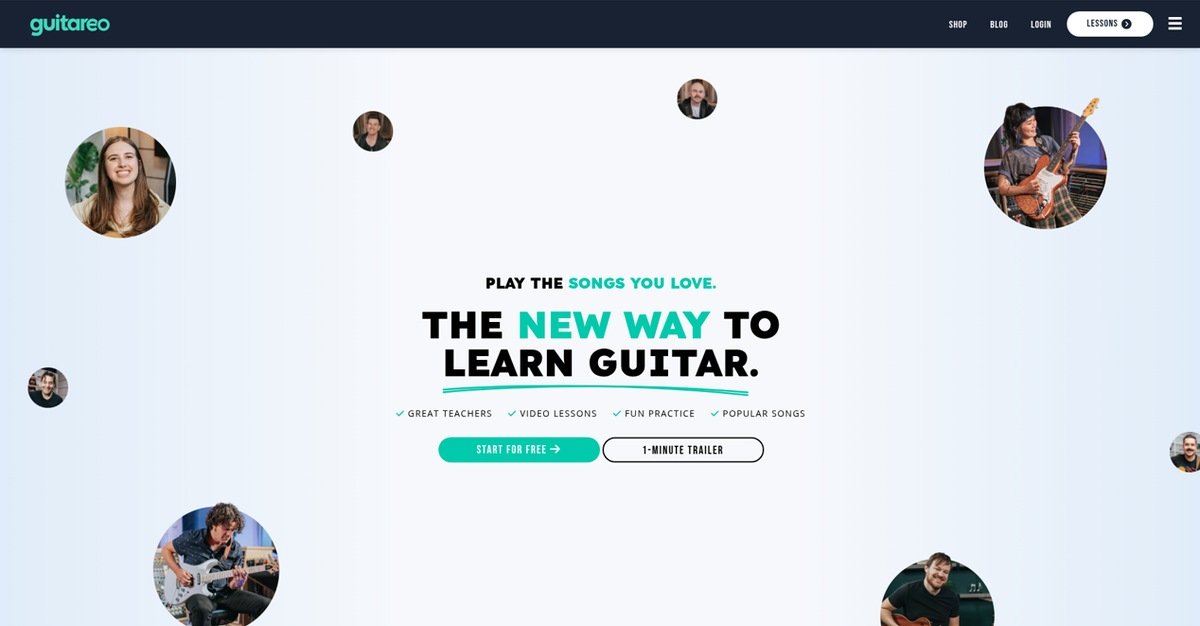
Guitareo is the guitar school of Musora, the Canadian company behind Drumeo, Pianote and Singeo, and it opened in 2018. Membership costs $30 a month or $279 a year, which works out to $23.25 a month. Both plans start with a 7-day free trial, and a 90-day money-back guarantee runs on after the trial ends.
The guitar lessons sit inside a Musora membership, so the same plan also opens drum, piano, singing and bass lessons at no extra cost. Every lesson is built as a follow-along session. You press play and practice with the teacher, rather than watching first and drilling alone later.
Verdict: The practice happens inside the video, and the membership covers four more instruments for the rest of the house.
Who is Guitareo best for?
Guitareo suits beginners who practice best when someone plays along with them, and who find an empty practice session hard to fill. It also makes sense for a household where one person wants guitar and another wants piano, drums or singing, since one membership covers them all.
What does a first week on Guitareo look like?
The first Method step assumes you have never held a guitar. It aims for a first chord on day one, then full chords and melodies within 10 days. Beginners can also take the Acoustic Guitarists Start Here or Electric Guitarists Start Here course with Ayla Tesler-Mabé, which covers essential chords and strumming patterns. For a taste before the trial, the free Song in an Hour Challenge has Rob Scallon teach the G chord, a chord change and a full song across nine videos.
How deep does the Guitareo Method go?
The Method runs in 12 steps. Early steps add scales for soloing, capo work, blues rhythms and arpeggios. The middle stretch covers alternate picking, palm muting, vibrato and legato, then works hammer-ons and pull-offs through all five CAGED shapes. The last steps teach soloing over chord changes, moving bass lines, extended chords such as the Hendrix chord, and Travis picking in 6/8 and 3/4. Alongside the Method sit more than 80 artist courses, including 30-Day Blues Guitar with Ally Venable and 30 Days To Faster Picking with Jason Richardson.
What do the live sessions and song tools add?
Members get weekly live Q&As, student lesson plans and what Guitareo calls unlimited personal support. The teaching roster includes Ayla Tesler-Mabé, Nate Savage, Rob Scallon, Mark Lettieri, Yvette Young and Dean Lamb. The song library holds 1,500+ transcriptions with tempo control, practice loops, a highlighted fretboard and guitar-less tracks, so you play the guitar part over the band.
Guitareo or a guitar-only school?
Guitar Tricks costs less a year ($179 against TrueFire’s $20.83 a month billed annually) and sells one-to-one coaching, but it teaches guitar alone. TrueFire goes further into style study. Andy Guitar also runs weekly live streams, at a lower price billed in pounds.
- Choose Guitareo if you want practice with a teacher on screen and lessons for the whole family on one bill.
- Choose Guitar Tricks if you want a lower yearly cost and a single guided road.
- Choose TrueFire if you are chasing jazz or blues depth.
Where it’s strong
- Every lesson doubles as a practice session
- Drum, piano, singing and bass lessons included
- 90-day money-back guarantee after the trial
- 1,500+ songs with tempo and loop tools
Where it falls short
- Annual plan costs $100 more than Guitar Tricks
- The free trial needs a card up front
Pick it if you want to practice along with a teacher and might add a second instrument. Skip it if you want the lowest yearly price for guitar alone.
Press play, pick up the guitar, and the practice has already started.
Full review: Guitareo review
How we evaluated these guitar lesson platforms
For this guide, we reviewed 9 of the guitar lesson platforms online. We assessed each curriculum, course structure and teacher lineup. We also checked the pricing, the trial and refund terms, and the ways each one gives feedback on your playing.
We then compared the platforms on the four factors in how we score lesson platforms. For setup and ease of use, we assessed how clearly each one lays out sign-up, plans and the next lesson. For quality of lessons and teachers, we looked at who teaches and how each course is built. That runs from Guitar Tricks’ Core Learning System to the single masters at ArtistWorks. For range of content, we compared styles, levels and song libraries, which vary widely here. For useful features, we weighed feedback options such as ArtistWorks Video Exchange and Guitar Tricks coaching. Live contact counted too, through Andy Guitar’s streams and Rock Like The Pros group lessons.
We found that no single platform leads on all four factors. So each review names the player it suits best. We list regular prices only and recheck them before every update. Commissions do not influence which products appear here or how they rank.
Also on our longlist, and why they missed the cut
Plenty of good platforms came close. Each one below is a real option, but for a player who wants a clear route from first chords onward, one of the nine above does the same job better or for less.
- Yousician: the app listens and scores your notes as you play, yet Fender Play already covers app feedback here. Yousician earns its place mainly if you want a second instrument on Premium Plus at $29.99 a month.
- Pickup Music: the CAGED pathway with Molly Miller and coach feedback videos suit improvers, but at $179.99 a year it costs as much as Guitar Tricks, and TrueFire covers the same stage of playing with a far bigger library.
- Gibson App: real-time feedback across 10,000+ lessons, exercises and songs makes it work much like Fender Play, and one app-style pick is enough for this list.
- Simply Guitar: friendly in the first week, but its plans sit inside the app, listed from $19.99 to $199.99 in the US App Store, so a like-for-like price check is hard.
- JTC Guitar: lessons from 100+ artists with interactive tab are a treat for licks and solos, but the London school prices in pounds and is built for intermediate and advanced players, not the first month.
Which online guitar lessons are best for beginners, improvers and advanced players?
Level matters more than library size. A beginner facing 85,000 lessons often practices less than one who has a single clear next step.
First chords. Guitar Tricks, Fender Play and JustinGuitar are the strongest starts. Guitar Tricks and JustinGuitar run a fixed order from tuning to full songs, while Fender Play puts a song you know inside each new skill. Andy Guitar’s free 10-day starter course is a gentle trial run before you pay anyone.
Past the open chords. This is the stretch where many players stall. TrueFire’s Learning Paths place you at a level and set 13 to 18 core courses in order. Marty Music sells goal-based courses such as Intermediate Foundation for Electric Guitar, and JustinGuitar’s intermediate grades move into blues and scales.
Advanced and style study. TrueFire’s faculty and the ArtistWorks schools go deepest. Paul Gilbert’s rock school at ArtistWorks runs from beginner to advanced, and players set on one genre, such as bluegrass, jazz or classical, get a master’s full method there.
Free guitar lessons or a paid course?
Free lessons can take you a long way. A paid course mostly buys a set order, better practice tools and, on some plans, a reply to your playing.
JustinGuitar puts a full graded course on its website at no cost, and Marty Music’s free courses and song lessons cover a lot of beginner ground. Guitar Tricks Basic gives you 24 lessons with a metronome and tuner, Andy Guitar’s free account includes the 10-day starter course, and Rock Like The Pros adds a free Strumming Mastery course.
The weak spot of free video is the gap between lessons. YouTube has the material, but you pick the order and the next step yourself, so the case for learning guitar from YouTube rests on how well you plan. A paid course sets the order and adds tools such as slow motion, looping and synced tab. If you want to stay free a while longer, these free guitar lessons on YouTube are the next place to look.
Live lessons, recorded courses or a teacher in the room?
Recorded courses give you order and replay, live online lessons give you correction, and a teacher in the room gives you both at the highest price. Most learners do well with a recorded course plus a live check now and then.
A recorded course lets you replay a chord change twenty times at half speed, which no weekly lesson can match. Its limit is that nobody watches your hands, so a tense wrist or a collapsing finger can go unnoticed for months.
A live online lesson is a video call with a teacher who corrects you as you play. Preply lists guitar tutors you book by the hour and offers a trial lesson. Lessonface runs lessons over Zoom as single lessons, packages or a weekly plan, and some of its teachers offer a free 15-minute trial. Til focuses on guitar and bass, with private and small-group classes from more than 50 teachers. Among the nine above, Guitar Tricks sells live lessons through its coaching menu, while Andy Guitar, Rock Like The Pros and Guitareo run group sessions.
A teacher in the room spots tension the moment it appears. Feedback is the real dividing line between online and in-person guitar lessons. It is also the first thing to check if you wonder whether online guitar lessons are effective.
How much do online guitar lessons cost?
Online guitar lessons cost from $0 to about $30 a month, or around $65 to $280 a year on annual plans. Single courses from Rock Like The Pros and Marty Music run from $37 to $92.
| Product | Lowest paid price | How you pay | Free way to start |
|---|---|---|---|
| Guitar Tricks | $179/yr; $29.95/mo | Subscription | Basic account; 14-day trial |
| Fender Play | $149.99/yr | Subscription | 7-day trial (14 days on annual) |
| JustinGuitar | Free; app $64.99/yr | Free website; app subscription | Free website course; 7-day app trial |
| TrueFire (with JamPlay) | $20.83/mo billed annually; $29.99 monthly | Subscription | 7-day trial |
| ArtistWorks | $191.88/yr Standard | Subscription | 7-day trial |
| Andy Guitar | £99.99/yr | Subscription | Free account, 10-day trial |
| Rock Like The Pros | $37 single course; $19.95/mo | Subscription or single course | Free strumming course |
| Marty Music | $68 single course | Single courses or membership | Free lessons |
| Guitareo | $279/yr; $30/mo | Subscription | 7-day trial |
Private teachers aren’t in this table, so look up typical guitar lesson costs if you are pricing one.
FAQs
What are the best online guitar lessons for beginners?
Guitar Tricks is the best paid choice for most beginners because its core path sets a clear order. Fender Play suits learners who prefer short app lessons, and JustinGuitar is the best free starting point.
Which online guitar lessons give feedback on your playing?
ArtistWorks Premium gives personal video replies at schools that offer it. Guitar Tricks lists a video feedback option, and Fender Play gives app feedback on songs and riffs.
Is it too late to learn guitar online as an adult?
No. Every course on this list starts from the basics and lets you set your own pace, and ArtistWorks runs two schools built for adult beginners. Age matters less than regular practice, and the first few months are the hardest at any age. How hard guitar is to learn comes down mostly to that early stretch.
Are online guitar lessons worth it?
They are worth it if you practice regularly. A $65 to $280 yearly plan costs less than a few private lessons, but you have to supply the discipline.
How long does it take to learn guitar, and how much should you practice?
Practice matters more than the platform. About 30 minutes on most days is a realistic target, and even 15 minutes keeps chord shapes fresh. Open chords and simple songs come first, while barre chords, the F chord above all, take longer. Whether half an hour a day is enough depends on how you split it, and the typical milestones for learning guitar show what each stage takes. Songs you like are what keep most players coming back.
What do you need for online guitar lessons?
You need a guitar that stays in tune, a tuner and a laptop or tablet big enough to show a teacher’s fretting hand. Acoustic and electric both work for every course here, so choose the one that suits your music. An electric also needs an amp or headphones, and a shortlist of electric guitars for beginners helps if you go that way. Live lessons add a webcam and a steady internet connection, and courses you download, such as Marty Music’s, let you practice offline.
Why do your fingers hurt when you start playing guitar?
New fingertips are soft, and pressing steel strings is hard on them for the first few weeks. Short sessions spread through the day help, and so do lighter strings or a nylon-string guitar. If you feel sharp pain in your hand or wrist, stop, rest and have a teacher look at your posture before you play again.
Is TrueFire or Guitar Tricks better?
Guitar Tricks is better for beginners who want a set path. TrueFire is better for players who want many styles. The rest of the detail lives in a side-by-side of TrueFire and Guitar Tricks.