Will
Fontaines D.C. made an album about the attention economy and built it like a feed: eleven sharp hits of mood, one genuine classic, and a center that doesn’t always hold.
Dopamine Chamber is the sound of a band turning its own concept into its structure. That’s the clever part, and occasionally the problem. A record about scrolling for the next spike plays like one, all jolts and switches, and it consolidates the reinvention of Romance rather than pushing past it.
Released October 16 on XL Recordings and produced again by James Ford, the 11-track record arrived behind three singles: “Marianne,” “Tongue” and “Where Is Gone?”, the Rosalía duet that gave the band their first-ever featured guest. It then moved more than 70,000 chart units in a week for a second UK No. 1. Grian Chatten pitched it as a “catastrophic warning”; Britain treated it as a coronation.
Chatten has said Romance was roughly 60 percent human and that this one “feels more like 60 percent corrupted”. Take him at his word. The guitars recede, the machinery moves in, and he stops reporting from the street and starts working the room like a salesman with something to sell you.
That tempter act is the best thing he has ever done. It’s also the album’s alibi: when the songs go slack, the persona does the heavy lifting, and too often it is asked to.
The studio work is genuinely inventive. For “Tongue,” Conor Deegan manipulated tape speeds for the low end while Carlos O’Connell ran Chatten’s voice through a sampler, and the result is thrilling in theory but less gripping than it should be. A few corners of Dopamine Chamber are like that: a fascinating process in search of a chorus.
Then comes “Where Is Gone?”, and the argument nearly collapses. Built on timpani, swelling strings and Western guitar, it is the most old-fashioned thing here and the most devastating, a duet that takes the album’s fear of screens and answers it with two people in a room.
It’s no accident that the best song on a record about artificial feeling is the one that sounds least artificial. That is the album’s real thesis, whether the band meant it or not.
“Marianne” earns its place too, a slow burner that undersold itself as a single and blooms in sequence; it’s now the album’s top-rated track among Album of the Year users. “Mimesis” is the sleeper, the one moment where the synth-pop gloss and the band’s pulse lock together without a seam showing.
Elsewhere, the seams show. The record lurches between moods rather than building through them, so every listener ends up with a different good half and a different bad one. A flawless album makes that argument for you. This one leaves a little of it on the table.
The soft middle is where it sags. “One Man” and “Japan” are the album’s weakest songs, pleasant where they should be pointed, and “Tongue” never decides whether it wants to menace or merely to impress.
In the catalog, Dopamine Chamber sits fourth of five: above A Hero’s Death, below Romance, Skinty Fia and Dogrel. That’s no insult in a catalog this strong. Romance changed what this band could be; this one refines it, mostly by changing the lighting.
The numbers tell the same story from the other side. Critics have it at 84 on Metacritic, while Album of the Year users sit at 78, level with Dogrel and above only A Hero’s Death in the band’s catalog. It’s a record that rewards patience more than first impressions.
The rollout’s one self-inflicted wound fits the thesis almost too neatly. The Dave Meyers-directed “Marianne” video initially credited “AI artists,” and Chatten told the Los Angeles Times that nobody in the band’s camp had been told, adding that AI is “literally rendering our souls obsolete.”
An album about technology hollowing people out, undercut by its own end credits. The irony wasn’t lost on him either.
None of this dents the band’s standing; if anything, it proves it. The album debuted at No. 14 on the Billboard 200 with career-high U.S. numbers, the European arena tour opened in Lisbon on October 21, and a week later they debuted “Demolition” live in Belgrade. A divisive record that still tops the chart is a luxury only very big bands get.
Luxuries run out, though. Fontaines now have one album that changed what they could be and one that deepened it; the sixth will need the nerve of Romance and the songbook of Skinty Fia at the same time.
Dopamine Chamber is a handsome, haunted record: essential for “Where Is Gone?”, strong almost everywhere else, and flawed only in the ways a band this ambitious can afford to be. Not their masterpiece. Still a very good album, and proof they can make the cold sound beautiful.
Score: 4/5
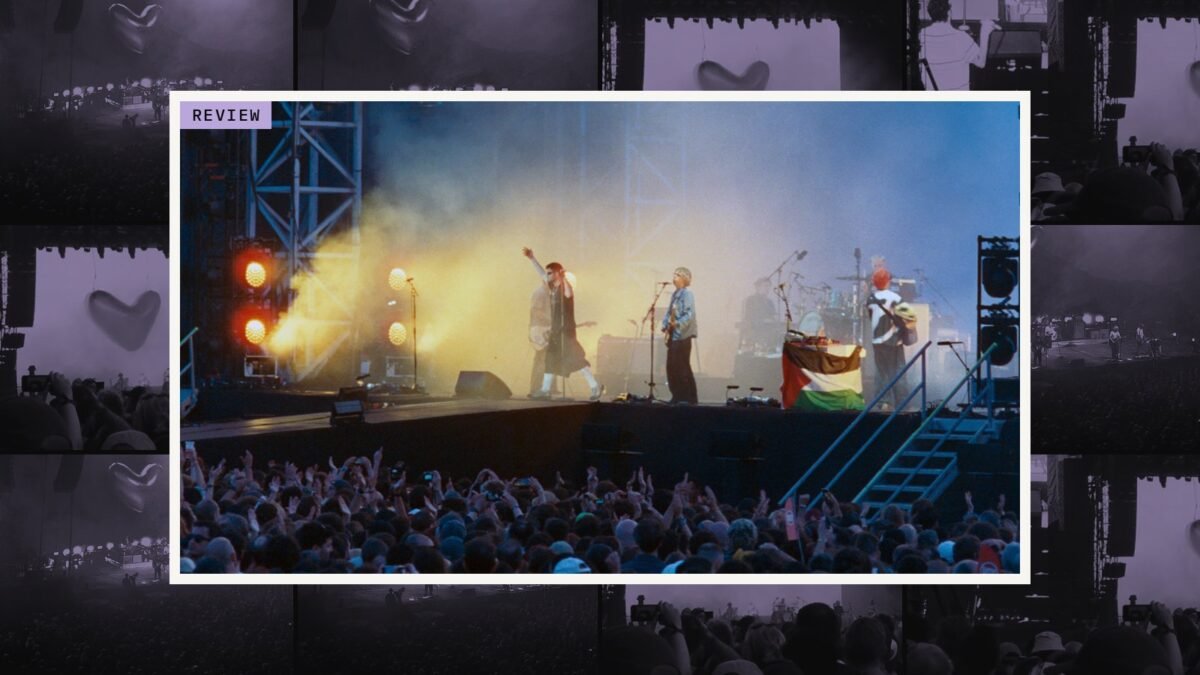
Featured image credit: Photo: Boredintheevening via Wikimedia Commons, CC BY 4.0 (cropped). Background images: Haggis MacHaggis and ManoSolo13241324 via Wikimedia Commons, CC0.