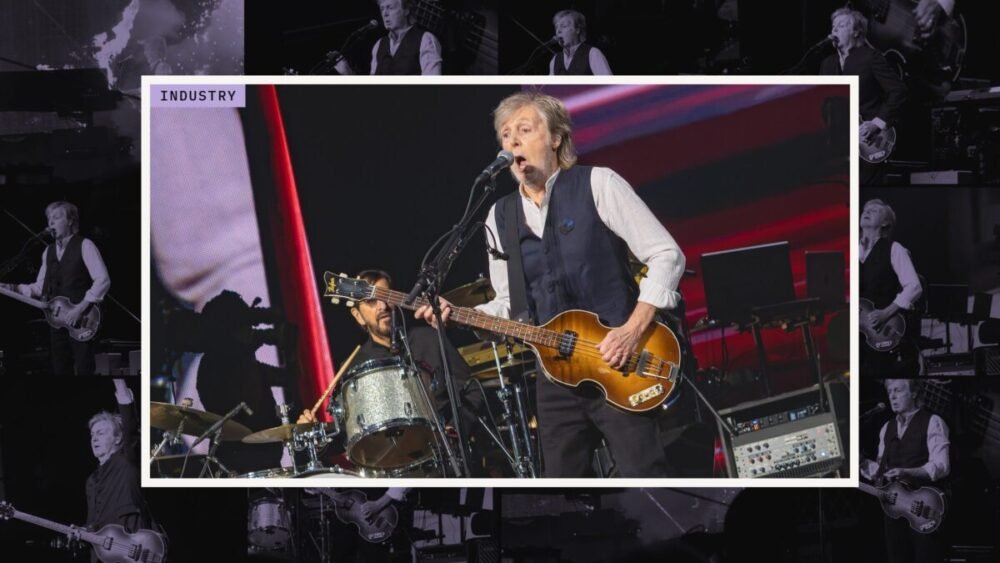
Of all the routes to becoming music’s newest billionaire, Paul McCartney has taken the least glamorous and the most devastatingly effective one: he simply never sold. Forbes estimates the 84-year-old Beatle is now a billionaire, and the most telling thing about the figure is what’s missing from it: a catalog sale.
While his peers cashed out at the top of the market, Macca kept the deeds.
Forbes puts his net worth at a minimum of $1.4 billion, third among musicians behind Jay-Z and Taylor Swift, which makes for one of the more delicious podiums in pop: a rap mogul, a stadium-era record breaker and a Beatle in his eighties. Line the fortunes up, though, and they tell wildly different stories about where music’s money lives.
| Musician | Forbes estimate | Where the money comes from |
|---|---|---|
| Jay-Z | $2.8 billion | Liquor, mostly: half of Armand de Brignac sold to LVMH in 2021, most of his D’Ussé stake sold to Bacardi in 2023, plus Roc Nation, Tidal, art and his catalog |
| Taylor Swift | $2 billion | Touring and royalties (nearly $800 million) and a catalog worth about $600 million, with her first six albums reacquired in May 2025 |
| Paul McCartney | $1.4 billion | Rights: MPL Communications ($250 million plus), his Apple Corps share ($150 million plus) and his Beatles songwriting share ($200 million plus), then touring, property and art |
Jay-Z is a spirits mogul who happens to rap; Swift built hers at stadium speed, then bought her own past back. McCartney is something altogether older-fashioned, a landlord, whose MPL Communications (founded in 1969, months before the Beatles split) holds his solo work plus a magpie-esque haul of other people’s songs, from Buddy Holly’s catalog to “Blue Christmas” and “Baby, It’s Cold Outside” (his own “Wonderful Christmastime” sits in the Forbes tally too, so festive season is royalty season twice over).
The Beatles songs came back the hard way, in a saga with more twists than the Abbey Road medley. Michael Jackson outbid him for the ATV catalog in the 1980s for $47.5 million, pop’s most awkward bit of friendly fire; the road home ran through a US Copyright Act clause letting writers reclaim rights signed away before 1978, and McCartney sued Sony/ATV in 2017 to have his share revert from October 5, 2018, before settling confidentially.
By our arithmetic that share is now worth at least $200 million, more than four times what the whole ATV catalog fetched when he lost it: revenge, served with interest.
Put MPL, his quarter of Apple Corps (split with Ringo and the estates of John and George, a company Forbes says throws off upward of $50 million a year) and that songwriting share together, and at least $600 million, roughly 43% of the estimate by our sums, sits in rights before a ticket from the 79 shows of the Got Back tour between 2022 and 2025 is counted. The stage made him famous; the paperwork made him a billionaire.
Set that against the catalog gold rush of 2020 and 2021, when rock’s elder statesmen lined up to sell. Bob Dylan handed Universal more than 600 songs for a reported $300 million plus; Stevie Nicks sold 80% of hers to Primary Wave at a valuation of about $100 million (Fleetwood Mac, forever the band that turns heartbreak into a business plan); and Bruce Springsteen sold masters and publishing to Sony for around $500 million, which Variety pegged at roughly 33 times the catalog’s $15 million a year.
Rational trades all; McCartney, conspicuously, stayed out of the queue.
Run McCartney’s Beatles songwriting income (at least $10 million a year) through that Springsteen multiple and it lands nearer $330 million than Forbes’ $200 million floor (our arithmetic, not a price anyone has paid). Forbes’ numbers are minimums, in other words, and the billionaire badge may well be the conservative reading.
“Is it more noble if we don’t write for money, if we just write for art and love? … I think the two can coexist,” he once mused, as Forbes recalls. The balance sheet suggests he settled that debate a long time ago.
For working artists the lesson is blunt. Songwriter collections just hit a record $15.9 billion, and that money flows to whoever holds the copyright, rarely the act generating the plays.
Sell and you get one enormous check; keep it and you get paid every Christmas, which is how the Beatle who once lost his own songs to Michael Jackson ends up collecting on Buddy Holly’s.