A drum kit gives each limb its own job. Your right hand keeps time on the hi-hat, your left hand cracks the snare, your right foot drives the kick and your left foot holds the pedal, all at the same moment.
Nobody stumbles into that. Someone has to decide which limb learns what, and in which order.
Drumeo answers with 12 ordered steps, which makes it the best online drum lesson for beginners and intermediate players in 2026. Those paths sit beside 200+ artist courses and 2,500+ songs with drumless tracks, and the membership costs $30 a month or $279 a year after a free trial, which runs 30 days through our link (7 days is Drumeo’s standard offer).
Mike’s Lessons is the pick if you want one teacher to review your playing, and ArtistWorks brings Peter Erskine’s jazz school with video replies on Premium. Drum Channel holds masterclasses from Neil Peart and Chad Smith. Stephen’s Drum Shed turns songs into short daily missions, and Lessonface finds you a live teacher on Zoom.
Once all four limbs agree, the band stops glancing over its shoulder.
MIDDERMUSIC may earn a commission if you buy through some links on this page, at no extra cost to you. Commissions do not influence which products appear here or how they rank.
| Product | Best for | Score | Key points | Link |
|---|---|---|---|---|
| An ordered path plus a huge song libraryDrumeo | 12 paths, 200+ artist courses and 2,500+ songs with drumless tracks | 4.5/5 |
| Visit Drumeo |
| Feedback from one teacherMike's Lessons | Song Sessions you film and send to Mike Johnston, plus weekly live streams | 4.5/5 |
| Visit Mike's Lessons |
| Jazz and brushes with a legendArtistWorks | Peter Erskine's 140+ lessons and 1,810+ past video exchanges | 4.0/5 |
| Visit ArtistWorks |


Which online drum lessons are best for you?
Drumeo is the best start for most drummers, but your style, level and need for feedback decide the rest. Use this table to jump to the review that fits.
| Best for | Pick | Score | Why | Starts at |
|---|---|---|---|---|
| An ordered path plus a huge song library | Drumeo | 4.5/5 | 12 paths, 200+ artist courses and 2,500+ songs with drumless tracks | $30/mo; $279/yr |
| Feedback from one teacher | Mike’s Lessons | 4.5/5 | Song Sessions you film and send to Mike Johnston, plus weekly live streams | $29.99/mo; $269.90/yr |
| Jazz and brushes with a legend | ArtistWorks | 4/5 | Peter Erskine’s 140+ lessons and 1,810+ past video exchanges | $19.99/mo; $191.88/yr |
| Masterclasses from famous drummers | Drum Channel | 4/5 | 250+ courses, including Neil Peart and Chad Smith | $22/mo; $199/yr |
| A daily habit for adult beginners | Stephen’s Drum Shed | 4/5 | Weekly songs split into 10 to 15-minute daily missions | $29.99/mo; $259/yr |
| A live private teacher | Lessonface | 3.5/5 | 100+ vetted drum teachers on Zoom | About $37 per lesson on average |
How do you choose online drum lessons?
Start with the music you want to play, then decide how much a real drummer should see you. Drums feel easy for a day and then show you exactly where your timing drifts.
- Style: Drumeo and Mike’s Lessons cover every major style, and Drum Channel spans rock to jazz. ArtistWorks is a jazz school, and Stephen’s Drum Shed teaches through well-known songs.
- Feedback: Mike’s Lessons reviews the videos you send through its Sessions, and ArtistWorks Premium answers videos too. Lessonface teachers correct you live, and the rest are mostly self-guided.
- Level: every program here starts at zero. Drum Channel’s method also teaches reading, and ArtistWorks runs to an advanced jazz level.
- Kit: an acoustic or electronic kit works for every program, and some first lessons need only a practice pad. If you still need a quiet kit, start with these electronic drum sets, and the kit section further down weighs pad, e-kit and acoustic.
- Price model: Lessonface charges per lesson, and the other five are subscriptions with monthly and annual plans.
- Free start: Drumeo gives 30 days free through our link (7 days as standard), ArtistWorks and Drum Channel give you 7 days free, Mike’s Lessons gives a week, and Stephen’s Drum Shed gives 14 days.
1. Drumeo: best for an ordered path plus a huge song library

Drumeo is the drum side of Musora, a Canadian company based in Abbotsford, British Columbia. Its drum method runs as 12 step-by-step paths, and the first five hold 34 to 36 lessons each. Every lesson is a follow-along video, so you play while the teacher plays.
It ranks first because it joins a clear order of study to the largest set of teachers and songs here. Coaches include Larnell Lewis on gospel, Steve Smith on jazz, Gene Hoglan on metal and Anika Nilles on subdivisions.
Verdict: The most complete drum school online, with a path that tells you what to practice next and a song library that keeps practice fun.
Who is Drumeo best for?
It suits beginners who want a plan and intermediate players who want new styles without changing schools. Drummers who learn through songs get the most from it, since every song comes with a drumless track for you to fill.
What does a first week on Drumeo look like?
You open the first method path, a run of 35 follow-along lessons, and play along with the teacher from the first video. The Progress Tracker logs every lesson and practice session. Streaks count your daily and weekly practice, so a missed day is easy to spot.
Who teaches the artist courses?
The coaches page sorts teachers by style. Stanton Moore covers New Orleans, Todd Sucherman rock, Dennis Chambers funk and Greyson Nekrutman big band. Technique courses include Claus Hessler on open-handed drumming, Dom Famularo on pedal control, Tommy Igoe on groove essentials and Sarah Thawer on 4-way coordination.
Can you get feedback on Drumeo?
Drumeo is mostly self-guided, but members can send a video for a Student Review, and a mentor replies by video, in writing or on a quick call, usually within ten business days. Weekly live Q&As and unlimited personal support round it out. Pair it with a few live lessons if you want someone to correct you as you play.
What does Drumeo cost?
Membership costs $30 a month or $279 a year, which works out to $23.25 a month. A free trial comes first, 30 days through our link or 7 days as standard, and a 90-day money-back guarantee follows.
A cheaper lessons-only plan saves 17% but drops the songs. The detailed Drumeo review covers the method, songs, pricing and feedback.
Should you pick a big library or a teacher who watches you?
Mike’s Lessons has one teacher who watches the videos you send, and Lessonface gives you a live teacher every week.
- Choose Drumeo if you want the widest path and the biggest song library.
- Choose Mike’s Lessons if feedback matters most.
- Choose Lessonface if you need a teacher in real time.
Where it’s strong
- 12 ordered paths from first beats to advanced playing
- 2,500+ songs with drumless tracks and sheet music
- A deep roster of famous coaches in every style
Where it falls short
- Video reviews come from Drumeo mentors, not the famous course teachers
- The song library needs the full plan, not lessons-only
Pick it if you want a clear path and endless songs to play. Skip it if you need a teacher to watch you every week.
With 2,500 drumless tracks waiting, the hardest choice is which song to play first.
2. Mike’s Lessons: best for feedback from one teacher

Mike’s Lessons is the online school of Mike Johnston, an educator and clinician who has taught drums online for more than 20 years. Modern Drummer named the site its “Educational Website of the Year.” The school says it offers one instructor for all styles and all levels.
It ranks second because Mike reviews the playing you send him. In its Sessions, you learn a song, film yourself playing along and submit the video, and the next course opens once you do.
Verdict: The closest thing to a weekly teacher in a self-paced school, with one consistent voice from your first groove to advanced independence.
Who is Mike’s Lessons best for?
It suits drummers who want one teacher to follow for years. Beginners get a clear entry point, and advanced players get hundreds of lessons on ghost notes, dynamics and creative independence. Players who learn best by reading also get notation with every lesson, and players who learn by ear can simply watch and copy.
What does a first week on Mike’s Lessons look like?
Start with the Starting From Scratch course, which removes the guesswork about where to begin. You can begin on a practice pad or electronic kit. By the weekend you can join the weekly live stream and ask Mike a question in real time.
How do Sessions work?
Each Session is a series of courses built around one song. You practice its parts, film yourself playing along to the track and send the video to Mike for review. That submission opens the next course, which keeps you accountable.
What else comes with the membership?
Topic courses walk you step by step through skills such as hand speed, foot speed, grooves and fills. Candy Shop adds fresh lessons for fun.
Every lesson is filmed in 4K with interactive notation, and practice logging tracks your progress. The free GrooveScribe tool lets you write out a groove, hear it play back and share it, which helps when you transcribe a favorite drummer.
What does Mike’s Lessons cost?
One plan gives full access for $29.99 a month, $149.95 for six months or $269.90 a year. The six-month plan saves about a month, and the annual plan saves about three. Your first week is free, and you can cancel during it.
How much does a one-teacher school give up?
Drumeo has many more teachers and a far larger song library, and Drum Channel brings dozens of famous names.
- Choose Mike’s Lessons if you want one teacher to review your playing.
- Choose Drumeo if you want variety.
- Choose Drum Channel if you love masterclasses.
Where it’s strong
- Video reviews from Mike built into the course path
- Weekly live streams with Q&A
- 4K lessons with interactive notation
Where it falls short
- One teacher’s style, with no other voices
- No published count of lessons or songs
Pick it if you want a teacher to hold you to your practice. Skip it if you want many teachers and a big song library.
For the basics of playing drums before your first Session, start with grip, count-ins and a simple rock beat.
3. ArtistWorks: best for jazz and brushes with a legend

ArtistWorks runs one drum school, and it belongs to Peter Erskine. He is a two-time GRAMMY winner, a ten-time Modern Drummer Best Jazz Drummer and a veteran of more than 700 recordings. He played with Weather Report, Chick Corea, Jaco Pastorius and Steely Dan.
It ranks third because it pairs a true jazz master with video feedback. His school holds 140+ lessons in three levels, and on Premium he records replies to the videos you send.
Verdict: The best online drum school for jazz, with brushes, odd meters and feel taught by a player who recorded with the legends.
Who is ArtistWorks best for?
It suits drummers who love jazz, from beginners holding sticks for the first time to rock players learning to swing. It also fits players heading toward odd meters, which get their own place in his curriculum. Big band and combo drummers will find the brush and repertoire lessons hard to match elsewhere.
What does a first week on ArtistWorks look like?
You start in the beginner level with “Holding the Sticks” and basic technique, and the intermediate level later moves on to hi-hat control. Watching a few exchanges from students at your level shows you what Peter listens for. On Premium, you can record your first submission before the trial ends.
What does Peter Erskine teach?
The school covers jazz technique, brush playing, odd meters, groove and feel, and jazz repertoire. Intermediate lessons include staccato to legato phrasing, and the advanced level has a whole lesson on listening. Exchanges range from a Brazilian blues bossa to brush playing, so the library teaches even when you never submit.
How does video feedback work?
You film yourself playing an assigned piece and upload it. Peter records a reply aimed at your playing, and it joins the shared library of 1,810+ exchanges. Standard members can watch every exchange but cannot send their own.
What does ArtistWorks drums cost?
Standard costs $19.99 a month or $191.88 a year, and Premium costs $29.99 a month or $287.88 a year. Premium adds personal feedback and a bonus library.
Both plans start with a 7-day free trial. The ArtistWorks review explains how the platform runs across every instrument.
Which school fits a drummer who doesn’t play jazz?
Drumeo covers rock, metal, gospel and pop with dozens of coaches, and Drum Channel offers Gregg Bissonette’s essential styles.
- Choose ArtistWorks if jazz is your goal and you want a master to hear you.
- Choose Drumeo for every other style.
Where it’s strong
- Personal video replies from Peter Erskine on Premium
- Deep brush and jazz repertoire lessons
- The lowest annual price here, at $191.88 for Standard
Where it falls short
- One style focus, with little rock or metal
- Feedback needs the Premium plan
Pick it if you want to swing like the drummer from Weather Report. Skip it if your heart belongs to heavy rock.
Few drummers get brush lessons from the man who played on the La La Land score.
4. Drum Channel: best for masterclasses from famous drummers

Drum Channel is a California company with more than 100 contributing artists. Its library holds 250+ courses and masterclasses, 600+ episodes and a set of drumless playalongs. The names on its course list read like a drum magazine cover.
It ranks fourth because it pairs those masterclasses with real structured paths. The DC Drum Set Workshop takes beginners through two levels, and The Drum Channel Method adds a college-level curriculum.
Verdict: The best place to study with famous drummers, with structured workshops underneath and a lower annual price than Drumeo.
Who is Drum Channel best for?
It suits drummers who learn by watching the greats and want structure behind them. Intermediate players will get the most from it, though the workshop levels make it workable from day one. Hand technique fans get several methods in one place, from Murray Spivack’s to Freddie Gruber’s.
What does a first week on Drum Channel look like?
Start with DC Drum Set Workshop Level One, which has 8 courses, 64 lessons and 13 playalongs. Level Two follows with 60 lessons and 33 playalongs. Each lesson pairs a demonstration with a playalong, so you practice the idea with music the same day.
Which famous drummers teach here?
Neil Peart teaches composition and articulation, and Chad Smith covers basic rock drumming his way. Chad Wackerman brings the Murray Spivack hand method, and Thomas Lang teaches double bass drum.
Gregg Bissonette teaches essential styles and an introduction to jazz, and Mike Clark shares jazz insights. Virgil Donati and JP Bouvet round out the list, and Adam Kuns runs a 40-lesson rudimental crash course.
What is The Drum Channel Method?
It is Mike Packer’s curriculum of 10 courses, 250 lessons and 60 playalongs. Drum Channel calls it a college-level course taught for decades. It covers technique, grooves, rudiments and reading, so it suits players who want a full education.
What does Drum Channel cost?
Drum Channel costs $22 a month or $199 a year, which works out to $16.59 a month. You get 7 days free, and a 90-day money-back guarantee backs the plan. That is the lowest annual price here for a library with many teachers, and the monthly plan lets you binge a few masterclasses first.
Is inspiration enough without someone checking your playing?
Mike’s Lessons reviews videos you send, and ArtistWorks does the same for jazz on Premium.
- Choose Drum Channel if you want inspiration and depth for less than Drumeo.
- Choose Mike’s Lessons if you need someone to check your playing.
Where it’s strong
- Masterclasses from Neil Peart, Chad Smith and Thomas Lang
- A college-level method with 250 lessons
- The lowest annual price here for a multi-teacher library
Where it falls short
- No feedback on your playing
- Fewer song lessons than Drumeo
Pick it if you want lessons from drummers you have posters of. Skip it if you need a teacher to check your progress.
A list of the greatest drummers of all time shows how many of these teachers earned their place.
5. Stephen’s Drum Shed: best for a daily habit for adult beginners

Stephen’s Drum Shed is the school of Stephen Taylor, a drummer with more than 30 years of performing, recording, touring and teaching. At 19 he was the house drummer at The Famous Door on Bourbon Street. Later he toured with The Steel Woods.
Its Drum Better Daily program ranks fifth because it solves the hardest part of adult practice: knowing what to do today. Each week brings one or two songs, split into five daily missions of 10 to 15 minutes.
Verdict: The easiest way for busy adults to practice every day, with songs as the lesson plan and a weekly live call for questions.
Who is Stephen’s Drum Shed best for?
It suits adults who start, stop and start again. If you sit down with ten free minutes and no idea what to play, the daily mission answers the question for you. Returning drummers who never learned properly can begin with The Warrior Way and rebuild the basics.
What does a first week at Stephen’s Drum Shed look like?
Complete beginners start with the 21 Days to Drumming plan. Each day you open your dashboard, play the mission and log it. An acoustic or electronic kit works, and some early exercises need only a practice pad.
What comes beyond the daily missions?
Members get 70+ lesson tracks in categories such as basics, grooves, rudiments, jazz, world rhythms and linear drumming. Tracks come with PDF books, sheet music, practice logs and goal worksheets. The Warrior Way adds a step-by-step beginner curriculum.
How much help do you get from Stephen?
Stephen hosts a weekly live Q&A coaching call, often with guest artists, and replays are kept for members who miss it. On request, he builds a personalized practice plan around your goals.
Lesson comments and email support cover the days in between, and you can also call the studio. A supportive member community adds encouragement when practice stalls.
What does Stephen’s Drum Shed cost?
Membership costs $29.99 a month or $259 a year, which works out to $21.58 a month. Both plans start with a 14-day free trial, the longest here, and you can cancel during it.
Does a small daily routine beat a giant catalog?
Drumeo has a far bigger song library and more teachers, and Mike’s Lessons reviews the videos you send.
- Choose Stephen’s Drum Shed if routine is your problem.
- Choose Drumeo if you want variety.
- Choose Mike’s Lessons if you want direct feedback.
Where it’s strong
- Short daily missions built around real songs
- A personal practice plan on request
- The longest free trial in this guide
Where it falls short
- No video review of your playing
- Less advanced material than Drum Channel
Pick it if you need a reason to sit down at the kit every day. Skip it if you are already gigging and want advanced study.
Ten minutes a day sounds small until you count up a year of them. These affordable drum sets cover the kit for that year.
6. Lessonface: best for a live private teacher

Lessonface is a marketplace for live music lessons, and it lists more than 100 vetted drum teachers. Staff experts screen each teacher, and verified students leave the reviews. The average drum lesson costs about $37.
It ranks sixth because it is the only option here with a teacher watching you in real time. That makes it the best fix for grip, posture and timing problems that a video cannot see, and the teacher can adjust each lesson to the music you want to play.
Verdict: The best way to get a real drum teacher on a screen, with rates and styles chosen by you.
Who is Lessonface best for?
It suits drummers who want a weekly teacher and kids who need a live adult guiding them. It also helps self-taught players who have hit a wall they cannot see. Snare, marimba and timpani students can find specialist teachers too, which no subscription here offers.
What does a first lesson look like?
You pick a teacher, book a first lesson or trial and meet on Zoom. Lessonface sends the link and reminders.
Your recordings, assignments and notes stay in your account for practice between lessons. Many teachers post demo videos on their profiles, so you can hear them play before you book. If the fit is wrong, booking a different teacher takes minutes.
Who teaches drums on Lessonface?
The drum page shows each teacher’s years on Lessonface, rate and reviews. Featured teachers include Aaron Crouch, who toured for 13 years with Ringling Brothers and Barnum and Bailey Circus.
Christian Bruni holds a music performance degree from the Music Academy of Bologna. Other teachers on the page cover rock, jazz and kids.
How flexible are Lessonface bookings?
You can book single lessons or set up a weekly time. Time zones convert automatically, and you can reschedule or cancel up to 24 hours before a lesson. Group sessions and a few self-paced courses add cheaper options.
What does Lessonface cost?
Each teacher sets a rate, and the average drum lesson costs about $37. Featured rates run from $15 to $40 for 30 minutes.
Group sessions average about $53, and there is no subscription. You can pay lesson by lesson, buy a package or keep a weekly slot, so the cost follows how often you play.
Is a live teacher worth more than a monthly membership?
Drumeo costs less than one lesson a month and gives you a full path, while Mike’s Lessons reviews your videos for a similar price.
- Choose Lessonface if you need a teacher to watch you live.
- Choose Drumeo if you want the cheaper path.
Many drummers combine the two.
Where it’s strong
- A live teacher who corrects you in real time
- 100+ vetted drum teachers at different rates
- Lesson recordings and notes kept in your account
Where it falls short
- Weekly lessons cost more than any subscription here
- Quality depends on the teacher you choose
Pick it if you want someone to watch your sticks every week. Skip it if you want a full library on a small budget.
A teacher can spot a stiff wrist in seconds that a video would miss for months.
How we evaluated these drum lesson platforms
For this guide, we reviewed 6 of the drum lesson platforms online. We assessed each curriculum, course structure and teacher lineup. We also checked the pricing, the trial and refund terms, and the ways each one gives feedback on your playing.
We then compared the platforms on the four factors in how we score lesson platforms. For setup and ease of use, we assessed how clearly each one lays out sign-up, plans and the next lesson.
For quality of lessons and teachers, we looked at who teaches and how each course is built. That runs from Drumeo’s 12 ordered paths to Peter Erskine’s jazz school at ArtistWorks.
For range of content, we compared styles, levels and song libraries, from famous masterclasses on Drum Channel to daily song missions. For useful features, we weighed feedback options such as Mike’s Lessons Sessions and ArtistWorks Premium video replies. Live contact counted too, through weekly live streams, Q&A calls and Lessonface teachers on Zoom.
We found that no single platform leads on all four factors. So each review names the drummer it suits best.
We list regular prices only and recheck them before every update. Commissions do not influence which products appear here or how they rank.
Practice pad, electronic kit or acoustic kit: what should you learn on?
Every school above assumes you can hit something, but none of them needs you to own a full kit on day one. What you play on changes the noise, the cost and the kind of feedback you can get.
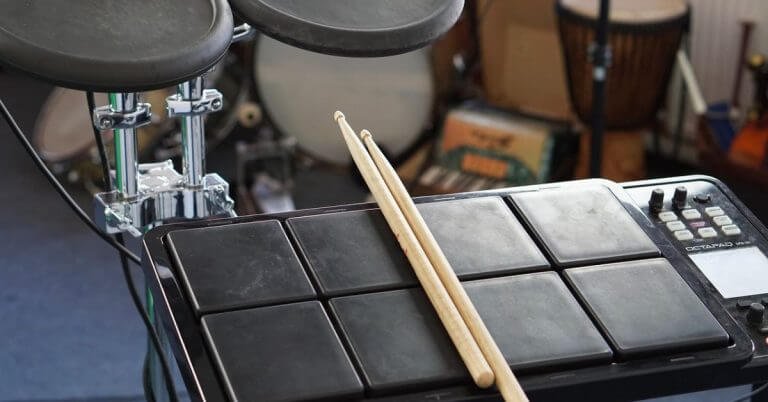
- Practice pad: a rubber pad and a pair of sticks cost little and barely disturb anyone. Grip, rudiments and stick control all start here, and Mike’s Lessons says you can begin on one. A pad cannot train your feet, so plan to move on once your grooves need a kick drum.
- Electronic kit: headphones keep the household calm, and the MIDI output lets an app check every hit against the beat. That makes it the easiest kit for apps that grade your timing. These beginner electronic drum sets are a sensible place to start shopping.
- Acoustic kit: nothing else teaches dynamics, cymbal feel and the push of a real bass drum as well. It is loud, so your practice hours depend on the people around you. Learn the parts of a drum set first, and a teacher’s talk of floor toms and ride bells will make sense straight away.
Whatever you play on, keep a metronome running from the first week. The drummer is the clock for the whole band, and a click exposes a rushing fill faster than any teacher can.
Heard of Melodics or Drum Ambition? Where the other names fit
Other drum guides lean on a few names that are not reviewed here. Here is where each one fits beside the six above.
- Melodics is an app that listens while you play. It plugs into an electronic kit over MIDI, hears an acoustic kit through audio detection with no extra hardware, and scores taps on a practice pad too. Lessons and song tutorials sit in beginner, intermediate and advanced paths, and the desktop app starts with a 7-day free trial. Superb for daily timing practice, though nobody checks your posture.
- Drum Ambition is a beginner school led by one teacher, Simon DasGupta, who has taught drums for more than 25 years. It costs $29 a month or $199 a year and comes with a 14-day money-back guarantee. A calm first step, but it is built for beginners rather than players chasing advanced styles.
- Dave Weckl Online School holds more than 70 hours of lessons and play-alongs, from setup and tuning to soloing, for $30 a month or $300 a year. Subscribers can put questions to Dave in a private Facebook group and on livestreams. It pays off most once the basics are solid.
- MasterClass has Sheila E. teaching drumming and percussion across 15 lessons, about two and a half hours in all, congas included. Treat it as inspiration rather than a method.
Are online drum lessons better than in-person lessons?
Online lessons cost less and let you replay a fill at half speed as often as you need. A teacher in the room can watch your feet and hands from every angle, and a band adds what neither gives you: holding time under real pressure.
A good online program sets the order and gives you clear notation and slow demonstrations. A local teacher fixes a tense shoulder or a heavy foot on the spot. If you learn mostly online, choose an option with human feedback, such as Mike’s Lessons, ArtistWorks Premium or a Lessonface teacher.
How much do online drum lessons cost?
Online drum lessons cost from $19.99 a month for a single-teacher school to about $37 for one live lesson. Annual plans here run from $191.88 to $279 a year.
| Product | Lowest paid price | Free way to start |
|---|---|---|
| Drumeo | $30/mo; $279/yr | 30 days via our link (7 days standard) |
| Mike’s Lessons | $29.99/mo; $269.90/yr | One-week trial |
| ArtistWorks | $19.99/mo; $191.88/yr | 7-day trial |
| Drum Channel | $22/mo; $199/yr | 7 days free |
| Stephen’s Drum Shed | $29.99/mo; $259/yr | 14-day trial |
| Lessonface | Set by teacher; about $37 average | First lesson or trial where offered |
Every groove needs a bass player to lock in with, and the online bass lessons that build that pocket are ranked the same way.
FAQs
What are the best online drum lessons for beginners?
Drumeo is the best choice for most beginners, with 12 ordered paths and a free trial (30 days through our link). Stephen’s Drum Shed suits adults who want short daily practice, and Mike’s Lessons adds video feedback.
Can you learn drums online by yourself?
Yes, with a structured course and a metronome. Timing and posture are hard to judge alone, so record yourself often or get feedback from a teacher.
Which online drum lessons give feedback on your playing?
Mike’s Lessons reviews the videos you send through its Sessions, and ArtistWorks Premium does the same with Peter Erskine. Lessonface teachers correct you live.
Do you need a drum kit to start online lessons?
No. A practice pad covers grip and rudiments, and Mike’s Lessons says you can begin on one. An electronic kit works for every program here, and the kit comparison above sets out what each option teaches. A cajon is another quiet way to practice rhythm at home.
Do you need to read drum notation to learn online?
No, but it helps sooner than you might expect. Drum notation is simpler than piano music, because each line or space stands for a drum or cymbal rather than a pitch. Drumeo pairs its songs with sheet music, and Drum Channel’s method teaches reading as part of the course.
Can you learn drums from free YouTube videos?
You can start there. Free videos cover grips, first beats and simple fills, but nobody puts them in order or checks your timing. Use them to test your interest, then move to a course with a set path once you practice most days. A list of great drum songs to learn gives you targets to aim for.
What is the cheapest way to learn drums online?
Drum Channel is the cheapest full library at $199 a year. ArtistWorks Standard costs $191.88 a year but teaches jazz only.
Where can you learn jazz drums online?
ArtistWorks has Peter Erskine’s jazz school with brushes and repertoire. Drum Channel adds Gregg Bissonette’s introduction to jazz, and Drumeo has Steve Smith.
Are online drum lessons worth it?
Yes, if you practice. Most memberships here cost $20 to $30 a month, less than one average Lessonface lesson. Every other instrument is covered in the complete guide to online music lessons.